Table of Contents
LS Central vs Dynamics 365 Commerce
If you’re choosing a retail management platform in the Microsoft ecosystem, the shortlist usually comes down to two names: LS Central and Dynamics 365 Commerce (part of the Finance & Operations family, so you’ll also hear it called F&O Commerce or FnO Commerce). Both deliver POS, store operations, inventory, and omnichannel retail but they sit on completely different foundations, target different company sizes, and carry very different cost and implementation profiles. Picking the wrong one is an expensive mistake to unwind. This guide breaks down the real differences so you can match the platform to your business, not the other way around.
The short answer
LS Central is a unified retail solution built inside Dynamics 365 Business Central — ERP and POS in one application, one database. It fits small to mid-market retail, restaurants, hospitality, pharmacy, and forecourt businesses that want everything in one system without integrations.
Dynamics 365 Commerce is Microsoft’s first-party enterprise commerce platform, built on the Finance & Operations stack with a headless commerce engine. It fits large, complex, often multi-national retailers that run — or plan to run — D365 Finance and Supply Chain Management.
What is LS Central?
LS Central is a unified commerce platform from LS Retail – the largest ISV in the Microsoft Dynamics ecosystem – built directly on top of Dynamics 365 Business Central. It’s not an integration; it’s a native extension. POS, store operations, inventory, replenishment, loyalty, e-commerce connections, and the full ERP (finance, purchasing, supply chain) run in one application on one database.
That single-platform design is the whole pitch: a sale at the till hits inventory and the general ledger in the same system, with no middleware to build or maintain. LS Central ships in industry-specific editions – Retail, Restaurants, Hospitality (hotels), Pharmacy, and Forecourt – that share the same core but add specialized workflows like table management, bookings, prescriptions, or fuel operations. It typically serves businesses from around 10 to 250+ users, from single-brand chains to fast-growing multi-country operators. And because it lives inside Business Central, customization uses the same AL extension model your BC developers already know.
What is Dynamics 365 Commerce (F&O Commerce)?
Dynamics 365 Commerce is Microsoft’s own first-party retail platform, the successor to Dynamics 365 Retail and, before that, AX for Retail. It belongs to the Finance & Operations (F&O) family, which is why practitioners often call it F&O Commerce or FnO Commerce. It shares its back office called Commerce headquarters with Dynamics 365 Finance and Supply Chain Management.
Architecturally it’s a distributed, enterprise-grade design. The Commerce Scale Unit (CSU) hosts a headless commerce engine — the central API layer that powers every channel: the Store Commerce app (the modern POS that unified the older MPOS and Cloud POS), a built-in e-commerce storefront with its own site builder, call centers, and any custom channel a partner builds against the same APIs. Scale Units can run in Microsoft’s cloud or self-hosted in stores for resilience. Around it sit native hooks into Dynamics 365 Fraud Protection, Customer Insights, and Azure search. Customization happens in X++ and the Commerce SDK a different skill set and a heavier development lifecycle than Business Central’s AL extensions.
LS Central vs Dynamics 365 Commerce: head-to-head
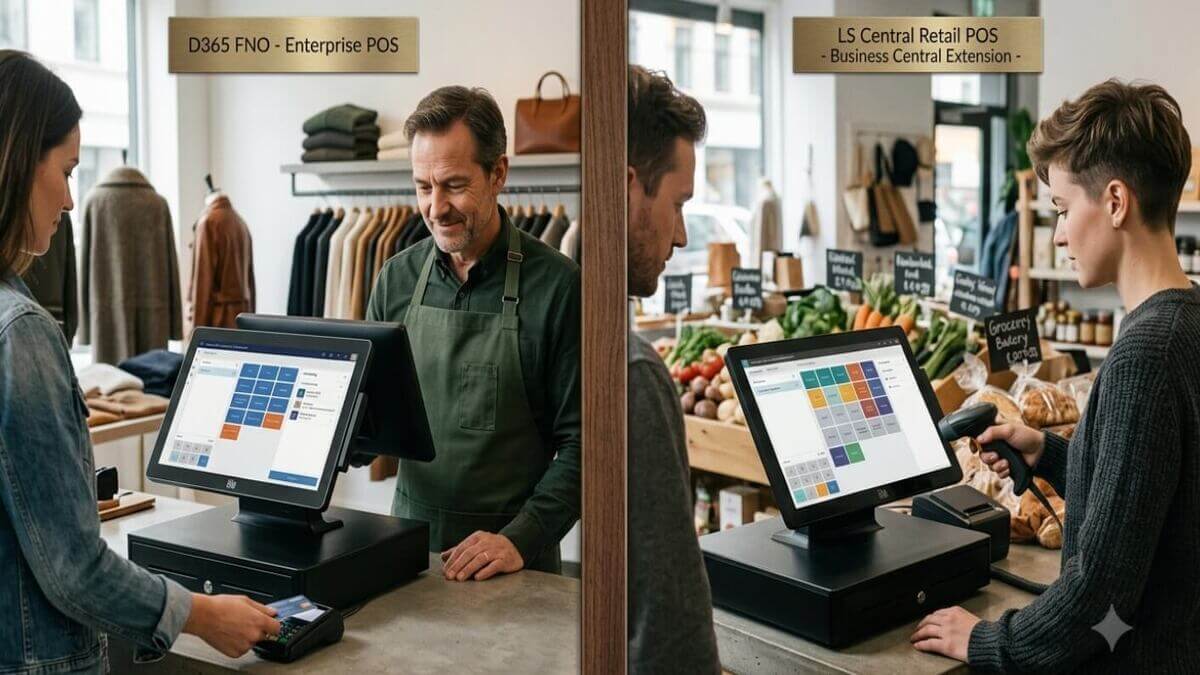
Following table shows the quick comparison between LS Central D365 Commerce products.
| LS Central | Dynamics 365 Commerce | |
|---|---|---|
| Built by | LS Retail (Microsoft’s largest Dynamics ISV) | Microsoft (first-party app) |
| Platform | Dynamics 365 Business Central (native extension, one app, one database) | Finance & Operations stack (shared with D365 Finance & SCM) |
| Architecture | Unified — POS and ERP in the same application | Distributed — Commerce HQ + headless Commerce Scale Unit (cloud or self-hosted) powering every channel via APIs |
| POS | LS Central POS with offline support; self-checkout, ScanPayGo, mobile POS add-ons | Store Commerce app (unified MPOS/CPOS) with offline database option |
| E-commerce | Connects to e-commerce platforms (e.g. Shopify, Magento connectors) | Built-in e-commerce storefront with site builder, plus headless APIs for custom fronts |
| Industry editions | Retail, Restaurants, Hospitality, Pharmacy, Forecourt — out of the box | General retail focus; verticals via partner solutions |
| Typical company size | SMB to mid-market (~10–250+ users), growing chains | Upper mid-market to large enterprise, often multi-national |
| Customization | AL extensions (Business Central developers) | X++ and Commerce SDK (F&O developers) |
| Licensing profile | Business Central licensing + LS Central components, via partners — lower entry point | Enterprise D365 tier licensing; often paired with Finance/SCM licenses — significantly higher entry point |
| Implementation | Weeks to months; single system to configure | Months to a year+; enterprise program with multiple components |
The real difference is the foundation, not the features
Feature checklists on both sides look similar POS, promotions, loyalty, inventory, omnichannel. The decision really hinges on which ERP world you live in.
LS Central is Business Central with retail built in. If your finance and operations run (or will run) on Business Central, LS Central gives you retail without a second system: one database, one upgrade cycle, one set of AL developers. The trade off is that you inherit Business Central’s scale envelope superb for SMB and mid-market, but very large enterprises can outgrow it.
Dynamics 365 Commerce is the opposite bet. Its headless Commerce Scale Unit is built for enterprise-grade volume, hundreds of stores, and custom channels talking to one API layer and it plugs natively into D365 Finance and Supply Chain Management. The trade-off is weight: enterprise licensing, X++ development, and an implementation program measured in months or years. Choosing Commerce effectively means choosing the whole F&O stack.
Cost and implementation: what to actually expect
Exact pricing depends on user counts, store counts, and your partner but the shape of the cost is predictable:
- LS Central rides on Business Central licensing plus LS Retail’s components, sold through partners. The entry point is dramatically lower, and implementations for a typical chain run weeks to a few months because there’s one system to configure.
- Dynamics 365 Commerce uses enterprise D365 tier licensing, and in real projects it’s rarely alone most deployments pair it with D365 Finance and Supply Chain licenses for the users who need them. Implementations are enterprise programs: multiple environments, Commerce Scale Unit topology decisions, X++ customization, and timelines measured in months to a year or more.
- Total cost of ownership follows the same split: LS Central concentrates cost in the LS/BC license bundle and partner services; Commerce adds platform overhead (environments, ALM, specialized F&O developers) that only pays off at enterprise scale.
Which one should you choose?
Choose LS Central if…
Choose Dynamics 365 Commerce if…
Let the ERP decide. The retail features overlap far more than vendors admit; the foundations don’t. If Business Central is your ERP world — as it is for most small and mid-market businesses — LS Central is the natural choice: one system, familiar AL development, faster and cheaper to live. Choose Dynamics 365 Commerce when the rest of your business genuinely needs the F&O stack — enterprise volume, multi-entity complexity, and a headless engine for custom channels. Choosing Commerce for a mid-market chain because it’s “the Microsoft one” usually buys enterprise overhead without enterprise benefit.
Frequently asked questions
Is LS Central the same as Business Central?
What does “F&O Commerce” or “FnO Commerce” mean?
Can LS Central work with Dynamics 365 Finance instead of Business Central?
Which is cheaper, LS Central or Dynamics 365 Commerce?
Does Dynamics 365 Commerce include e-commerce?
What skills are needed to customize each?
Evaluating LS Central or planning a Business Central rollout for retail? Drop your questions in the comments and I’ll reply as soon as I can.