After working with ERP systems for more than two decades, one of the most common questions I hear is:
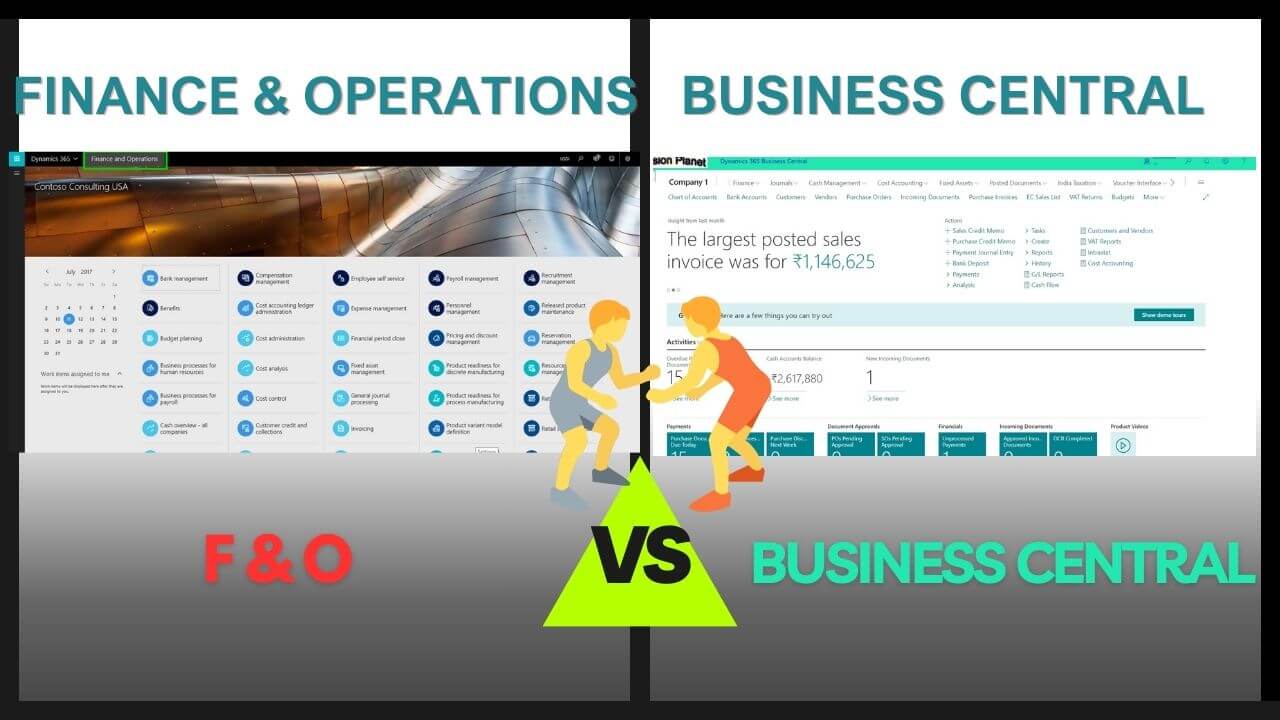
“Should we choose Business Central or Finance & Operations?”. After going though this post you will get clear comparison details for D365 BC vs F&O.
Both are powerful ERP products from Microsoft, but they are built for very different types of organizations. Let me explain in simple terms.
Table of Contents
Business Central (BC) – Designed for Growing Businesses
- Business Central is built for small and medium-sized businesses (SMBs).
- It includes everything in one system: finance, sales, purchasing, inventory, light manufacturing, and project management.
- It’s easier to set up, quicker to deploy, and works smoothly with Microsoft 365 tools like Excel, Outlook, and Power BI.
Best fit for:
- Companies with a few dozen to a few hundred employees.
- Businesses that need modern ERP but want to keep costs under control.
- Organizations that want flexibility without heavy complexity.
Finance & Operations (F&O) – Built for Large Enterprises
- F&O (often split into Dynamics 365 Finance and Dynamics 365 Supply Chain Management) is a full scale ERP for global organizations.
- It handles very complex needs like multi-country operations, advanced supply chain management, and global finance compliance.
- It requires more time and effort to implement but provides enterprise-grade depth.
Best fit for:
- Enterprises with thousands of employees.
- Global businesses working across many countries and currencies.
- Companies with highly complex finance, supply chain, or manufacturing processes.
Key Differences Between BC and F&O
D365 BC vs F&O Detail
Following table shows clear comparison details between BC and F&O.
| Feature | Business Central (BC) | Finance & Operations (F&O) |
|---|---|---|
| Target Audience | Small and Mid sized businesses | Large enterprises |
| Scope | Finance, sales, purchasing, inventory, light manufacturing, service | Advanced finance, global accounting, supply chain, HR, complex manufacturing |
| Ease of Use | User friendly, quick to learn | More complex, requires training |
| Cost | Lower subscription and implementation cost | Higher subscription and implementation cost |
| Scalability | Great for SMBs with growth plans | Built for global enterprises |
| Deployment Speed | Faster go live | Longer implementation |
| Integration | Strong with Office 365, Teams, Power BI | Deep enterprise integrations with Azure and advanced systems |
Consultant’s Advice – How to Choose
- If your business is small to medium sized and you need to be up and running quickly with controlled costs, choose Business Central.
- If you are a large enterprise with complex supply chain or finance needs across multiple countries, choose Finance & Operations.
- Think about where you are today and where you want to be in the next 5-10 years. That future vision should guide your choice.
FAQ – Business Central vs F&O
Yes, many companies begin with Business Central as they grow. If operations become more complex, they can later migrate to F&O with the right planning.
Business Central is much more cost-effective for SMBs. F&O comes with higher licensing and implementation costs, but it delivers value for large organizations with complex requirements.
No. Business Central can scale well for growing companies, but once you reach a global enterprise level with thousands of employees, F&O may become a better fit.
Yes, both BC and F&O are cloud based solutions offered under Microsoft Dynamics 365. On-premises options are available in some cases, but cloud is now the default.
Both integrate well, but Business Central is especially popular with SMBs because of its easy connection with Outlook, Excel, and Teams.